The quest to converse with whales began decades ago, rooted in wonder and scientific curiosity.
In the 1960s–70s, biologist Roger Payne popularized the haunting songs of humpback whales, igniting global conservation efforts.
By the late 2010s, researchers drew deeper parallels: whale communication systems could serve as a real-world proxy for detecting extraterrestrial intelligence, much like studying Antarctica to understand Mars.
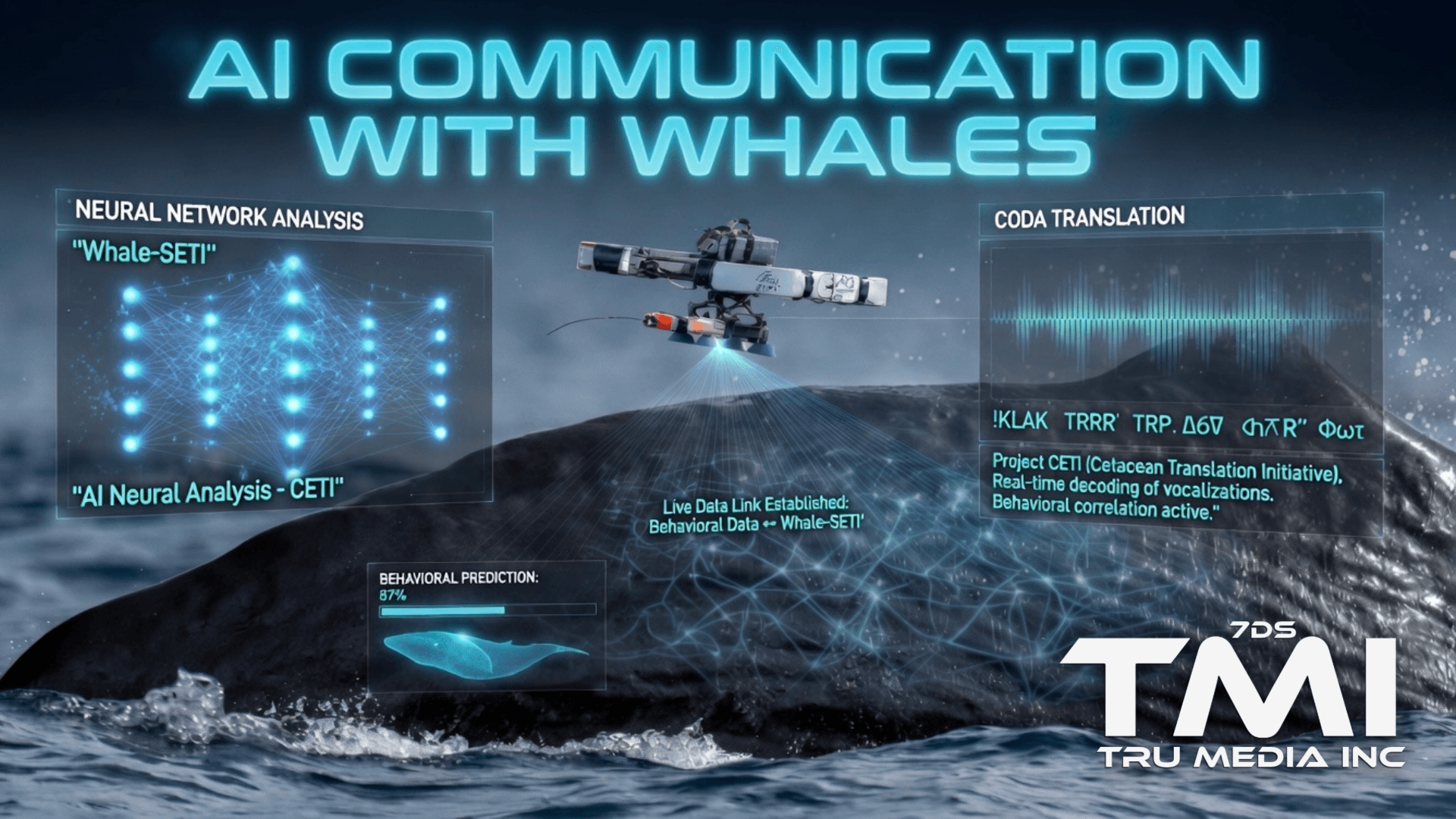
This led to the birth of Whale-SETI (a collaboration between the SETI Institute, UC Davis, and the Alaska Whale Foundation), which applies information theory and behavioral science to humpback calls.
Around the same time, in 2020, marine biologist David Gruber launched Project CETI (Cetacean Translation Initiative) with TED Audacious funding. CETI focuses on sperm whales, blending AI, linguistics, robotics, and massive datasets to decode their “codas” (click patterns) and aim for true translation.
The 2021 Breakthrough: “Conversing” with Twain
The pivotal moment came in December 2021 in Frederick Sound, Southeast Alaska.
Aboard the research vessel Glacier Seal, the Whale-SETI team—led by Dr. Brenda McCowan (UC Davis), with colleagues from the Alaska Whale Foundation and SETI Institute—conducted bioacoustic playback experiments.
They had been broadcasting various sounds with limited success that day. Then, they played a recorded “whup” or “throp”—a common humpback contact/greeting call from the local population.
To their astonishment, a 38-year-old female humpback named Twain (previously identified by fluke photos) broke away from her pod, approached the boat, and began circling it at around 100 meters.
What followed was a remarkable ~20-minute exchange:
Researchers played the call ~36 times, varying the intervals between playbacks.
Twain responded to nearly every one (33+ replies), dynamically matching the timing variations in a clear turn-taking pattern, much like a human conversation.
She engaged actively at first (strong vocal replies and circling), showed possible agitation in a middle phase, and eventually disengaged, swimming away while making a few final delayed calls even after the playbacks stopped.
This was the first documented intentional communicative exchange in humpback “language.” Twain’s replies were often louder and more powerful.
The encounter, analyzed with behavioral, respiratory, and acoustic data (including blind observers), demonstrated cognitive flexibility and social coordination.
The findings were published in PeerJ in 2023 as “Interactive Bioacoustic Playback as a Tool for Detecting and Exploring Nonhuman Intelligence.”
It remains the standout proof-of-concept, often highlighted in 2026 media as inspiration for SETI and interspecies understanding.
Looking Ahead: Future Plans
Whale-SETI plans follow-up playback and interaction studies in Alaska in late 2026, alongside a forthcoming paper on humpback bubble rings—large vortex rings blown during friendly human encounters (documented in 12 episodes in 2025, interpreted as possible inquisitive signaling or play).
Project CETI is advancing rapidly on sperm whales with real-time robotics (autonomous underwater gliders with “backseat driver” tech deployed in 2026 for passive tracking of vocalizations), expanded AI models (building on WhAM for synthetic codas and phonetic/vowel-like discoveries), and behavioral links (e.g., coda shifts during rare cooperative births documented in 2026).
They continue refining translation, open-source tools, and ethical/legal frameworks for conservation and animal rights.
These efforts blend awe with actionable science—potentially transforming how we understand and protect intelligent marine life while preparing tools for cosmic discovery.
The ocean’s “conversations” are just beginning.