The story of Alt Escape began not with fanfare or a grand launch, but with a quiet frustration shared late one night in a half-dead voice chat.
A small group of friends—scattered across time zones, lifestyles, and interests—had grown tired of the usual online spaces.
Gaming servers were too competitive and toxic when you just wanted to talk. Artist communities felt gatekept and clique-y.
Tech discords drowned in memes or crypto spam.
Social media felt like shouting into an algorithm that never listened back. Everywhere they turned, the vibe was either too narrow or too poisoned.
One of them, a streamer who went by KSI Papa online (real name irrelevant—he'd long since blurred the line between persona and person), typed into the group chat at 3:47 AM:
"Why isn't there just... a place? Not for one thing. For everything.
Where you can promo your clan one minute, drop your SoundCloud the next, vent about your day job, then hop into a voice chat to play literally anything—or nothing at all."
Someone replied with a laughing emoji. Another said, "Because that would turn into chaos in five minutes."
But the seed was planted.
They started small.
A temporary server named "Escape Hatch" just for the six of them.
No roles, no bots at first, no rules beyond "don't be a dick."
Within a week it had ballooned to thirty people—friends of friends, lurkers from old servers, randoms who wandered in from shared Twitch raids.
The name evolved. Someone joked about "alt" as in alternative lifestyles, alternative accounts, alternative realities—then someone else pointed out it could stand for
"Alternate Escape."
A third person said it sounded like hitting Ctrl+Alt+Delete on real life.
Alt Escape stuck.
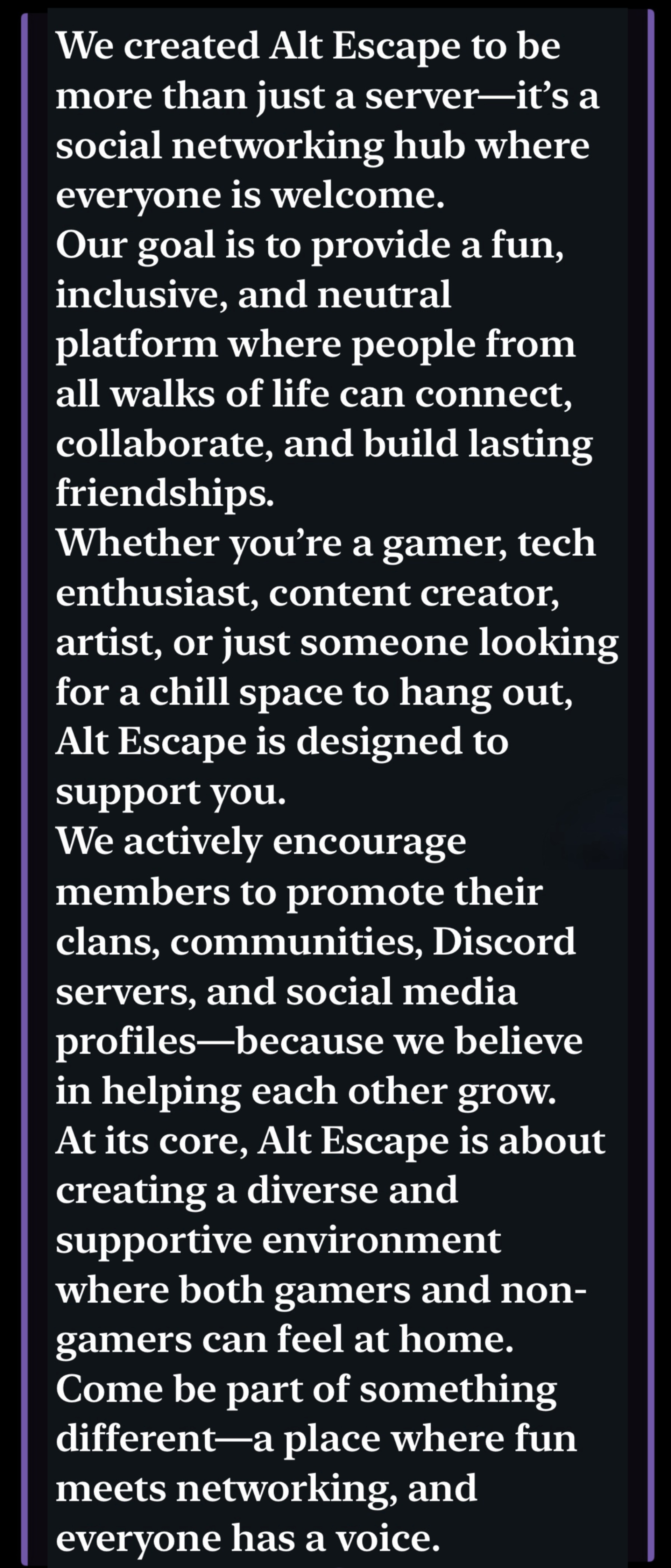
They rebuilt it from scratch with intention. The welcome channel wasn't a wall of rules—it was a manifesto:
No heavy moderation army.
Instead, a small circle of "Keepers"—the original crew plus a handful of early joiners who proved they could enforce fairness without turning into power-trippers.
The rule was simple: protect the space's spirit, not control it.
Word spread organically.
A Twitch streamer raided into the server during a "just chatting" session and left the invite in chat.
An indie artist posted their music in #self-promo and got genuine feedback—not bots, not empty likes—from people who actually listened.
A small esports clan used the #clan-recruit channel and found two new players who stuck around even after tryouts ended.
A non-gamer, a 40-something graphic designer tired of LinkedIn, discovered #creative-corner and started sharing WIPs again after years away from art.
The server grew to hundreds, then thousands. Categories multiplied thoughtfully:
- #welcome-mat → icebreakers, selfies-optional intros, "what brought you here?"
- #hangout-lounge → memes, music sharing, random vents
- #gaming-arcade → LFG for everything from Valorant to Stardew co-op to retro emulators
- #creator-spotlight → self-promo, collabs wanted, feedback threads
- #irl-escape → mental health check-ins, life advice, "tell me something good today"
- #network-nexus → job boards, freelance gigs, cross-promo for other Discords/Twitch/YouTube/TikTok
- Voice hubs with custom names that changed weekly based on community vote ("Midnight Philosophy", "Chaotic Cooking ASMR", "No Mic Just Vibes")
There were bumps.
Drama flared when someone tried to turn #self-promo into a spam-fest.
A crypto bro brigade attempted a takeover.
A few bad actors got banned, but the Keepers handled it transparently in an announcements channel—no witch hunts, just facts and "this is why."
The community self-policed more than any bot ever could.
Over time, Alt Escape became something rare: a digital third place.
Not a faceless platform, not a niche echo chamber, but a living room that scaled without losing its soul.
People met partners there. Business partnerships formed.
Friend groups that started in voice chat met IRL at conventions.
One member even crowdfunded a small indie game entirely through server collabs.
Years later, when someone asked the founders why it worked, KSI Papa just shrugged in a late-night VC.
"Because we stopped trying to be everything to everyone... and started being something real to anyone who showed up willing to be real back."
And so the invite link lived on, quietly passed from friend to stranger:
A small door in the vast internet, still open, still promising the same thing it always had:
An escape hatch.
An alternate path.
A place that felt—against all odds—like home.