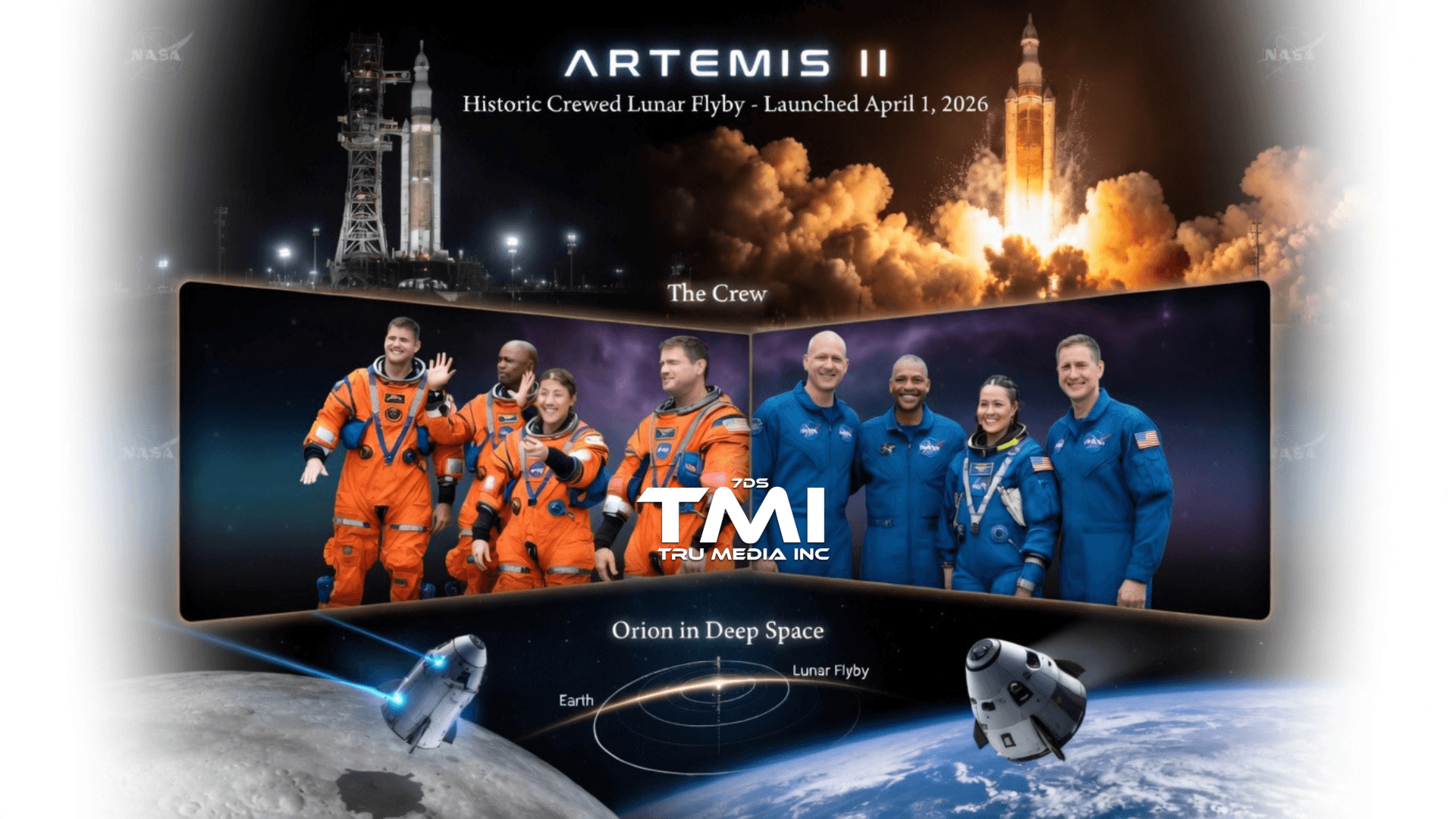
Artemis II Mission Update – April 2, 2026 (afternoon UTC)
NASA’s Artemis II continues to perform nominally roughly 20 hours after its historic liftoff on April 1 at 6:35 p.m. EDT (2235 UTC) from Kennedy Space Center’s Launch Complex 39B.
The SLS rocket delivered the Orion spacecraft and its four-person international crew into orbit flawlessly, marking the first crewed lunar mission since Apollo 17 in 1972.
Current Status
- Orion spacecraft has successfully separated from the SLS upper stage (Interim Cryogenic Propulsion Stage).
The European Service Module is now providing propulsion and power.
- All four solar arrays have deployed and are generating power.
- The crew has taken manual control of Orion for proximity operations and system tests, including successful maneuvers such as perigee and apogee raises.
- A brief communication loss with the crew shortly after liftoff was quickly resolved by ground teams.
- Minor issues noted (e.g., a toilet troubleshooting item) are being addressed in real time, with the crew reported as “safe, secure, and in great spirits.
The crew is healthy and actively conducting tests as Orion follows its trajectory for a distant lunar flyby.
On April 2–3, the spacecraft is expected to break the Apollo 13 record for farthest humans have traveled from Earth (approximately 248,655 miles).
The flyby itself (closest approach to the Moon ~6,000 miles) is targeted around April 6, followed by a Pacific Ocean splashdown around April 10–11.
The Crew
- Reid Wiseman (NASA, Commander)
- Victor Glover (NASA, Pilot — first Black astronaut on a lunar mission)
- Christina Koch (NASA — first woman on a lunar mission)
- Jeremy Hansen (Canadian Space Agency — first non-American on a lunar mission)
Live views from inside Orion show the astronauts smiling, waving, and busy with system checks.
NASA officials described the early mission phases as a success, praising the team’s quick handling of any post-launch anomalies.
Hype & Public Reaction
Excitement remains sky-high.
Social media is filled with celebrations of the “return to the Moon” after 53+ years, international collaboration, and inspiration for future Mars missions.
Daily mission status briefings from NASA Johnson are underway, and real-time tracking is available via NASA’s Artemis website and apps.
Post-launch press conferences highlighted the flawless rocket performance and the crew’s positive morale.
This ~10-day shakedown cruise is validating Orion’s deep-space capabilities (life support, navigation, heat shield, etc.) ahead of Artemis III’s planned crewed lunar landing later this decade.
Next milestones to watch:
- Continued system tests and burns en route to the Moon
- Lunar flyby and far-side views (April ~6)
- High-speed re-entry and splashdown (April ~10–11)
The mission is proceeding smoothly — a huge win for NASA, international partners, and human spaceflight. Safe travels to the crew aboard Orion Integrity! 🚀🌕
For the absolute latest, check NASA’s official Artemis II live blog or coverage on NASA+.