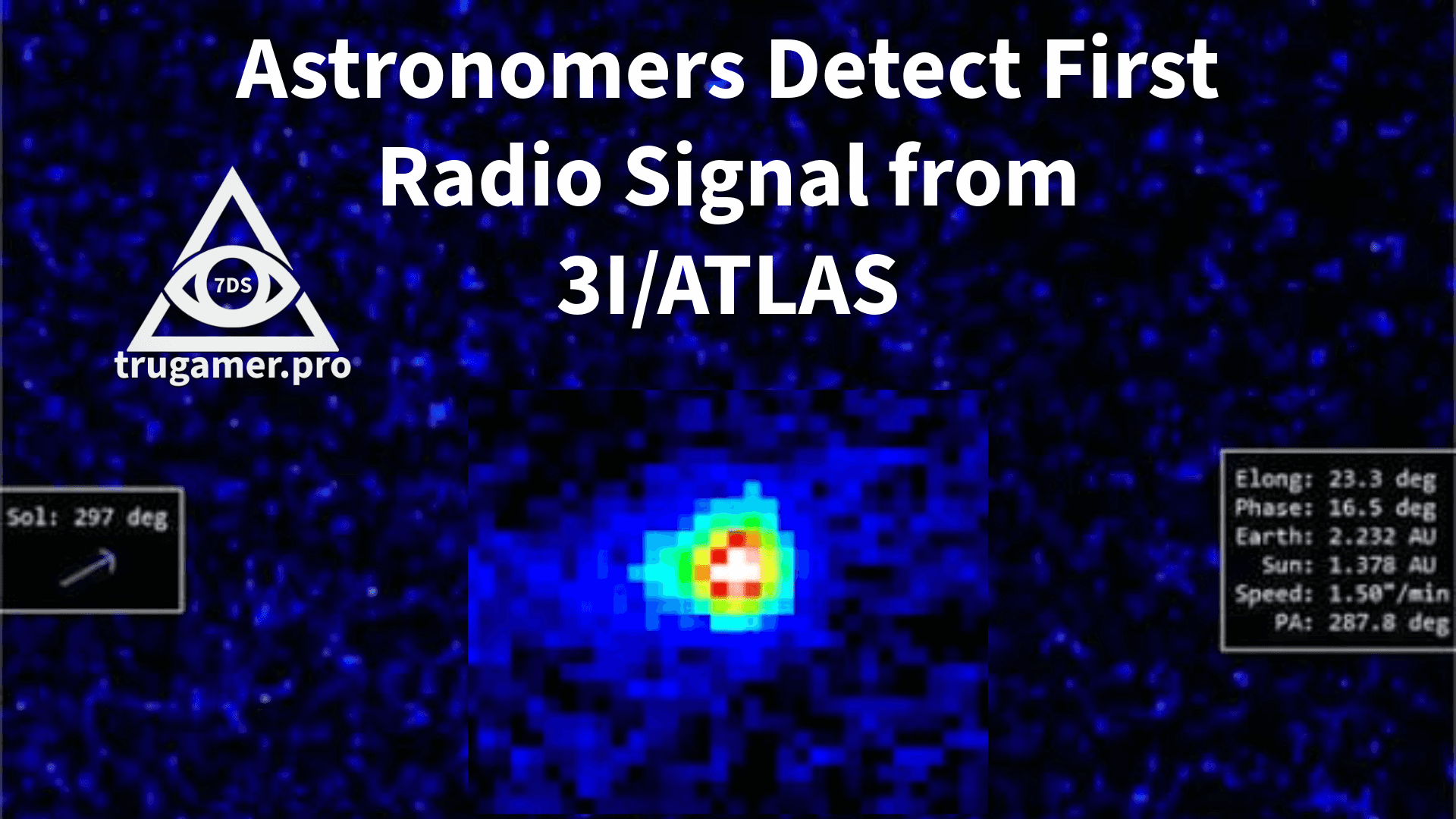
Also known as C/2025 G1 or comet 3I/ATLAS), a rare visitor from outside our solar system discovered in July 2025. This breakthrough, captured by South Africa's MeerKAT radio telescope array, has sparked both excitement and debate among experts. While some headlines sensationalize it as "unexplained signals," the data points to natural cometary activity—though Harvard astrophysicist Avi Loeb, a vocal proponent of extraterrestrial tech hypotheses, calls it a "rare opportunity" that challenges conventional models.
Key Details of the Discovery
- What Was Detected: On October 24, 2025—just five days before 3I/ATLAS reached its closest point to the Sun (perihelion on October 29)
—MeerKAT observed radio absorption lines at 1,665 MHz and 1,667 MHz. These are faint "dips" in radio waves caused by hydroxyl radicals (OH molecules), produced when water ice sublimates (vaporizes) under solar heat and breaks down via ultraviolet light. This is a hallmark of active comets, not artificial emissions.
- Why Now?: Earlier attempts on September 20 and 28 failed because the comet was farther from the Sun, producing less OH. The signal appeared as absorption (not emission) due to the object's proximity to the Sun, which favored this geometry.
- Object Background: 3I/ATLAS is the third confirmed interstellar object (after 'Oumuamua in 2017 and Borisov in 2019). It's hurtling through our system at over 130,000 mph (210,000 km/h), roughly Manhattan-sized, and shows unusual traits: high carbon dioxide content (with only ~4% water ice), color shifts (from red to blue), non-gravitational acceleration, and multiple jets of gas/dust. It passed solar conjunction (behind the Sun from Earth's view) earlier in October and is now visible in the morning sky with a growing tail.
Expert Claims and Interpretations
- Natural Comet Consensus: Most astronomers, including teams from the South African Radio Astronomy Observatory and NASA's James Webb Space Telescope (JWST), emphasize this confirms 3I/ATLAS as a battered, ancient comet—possibly billions of years old and unlike any in our solar system.
The OH signal aligns with "fire hose"-like water jets observed by JWST in October, ruling out explosions or excessive mass loss. As one WIRED report notes, it "ends the debate about its nature."
- Avi Loeb's Take: The Harvard professor, who has long speculated that interstellar objects like 'Oumuamua could be alien probes, hailed it as the "first radio detection of 3I/ATLAS" on his Medium blog.
He links the object's trajectory (within 9° of the 1977 "Wow!" signal's origin) to potential tech signatures and predicts NASA's Juno spacecraft will scan for low-frequency signals (50 Hz–40 MHz) during 3I/ATLAS's Jupiter flyby on March 16, 2026 (at ~53 million km). Loeb argues the jets and acceleration suggest "powered thrusters" with minimal mass loss, not typical comet behavior. However, he acknowledges no other signals (e.g., at the Wow! frequency of 1.42 GHz) have been found.
- Debunking Aliens: Outlets like Live Science and Gizmodo stress it's "further proof of its completely natural origins," dismissing extraterrestrial claims as distractions from real science—echoing the 'Oumuamua frenzy. No evidence of artificial narrowband signals or course corrections has emerged; anomalies like the "perihelion kick" (0.02 mm/s² acceleration) are attributed to uneven outgassing.
Social Media Buzz on X
The news has exploded on X, blending science with speculation:
- Posts from accounts like @nypost (1,735 likes) highlight Loeb's "alien engine" theory, while @dahboo7 shares videos of "seven jets" post-perihelion, calling it a "complex network."
- Conspiracy-tinged threads, like @3IATLASEXPOSED (663 likes), claim "nudging toward Earth" and "1.4 GHz pings," but these lack peer-reviewed backing.
- Balanced takes, such as @DilumSanjaya's (342 likes), note it's "too strange for an average comet, too few anomalies for a spaceship—probably something new."
- Recent shares (November 13) include YouTube breakdowns like "Radio Signal From 3I/ATLAS Stuns Astronomers" and Portuguese articles on its "larger tail and radio emission."
What's Next?
3I/ATLAS will peak in visibility around December 19, 2025, observable with amateur telescopes.
Ongoing monitoring by global observatories and Juno could reveal more about its composition—potentially reshaping our understanding of interstellar wanderers.
While Loeb's ideas fuel headlines, the radio signal tilts heavily toward a natural explanation, underscoring how these cosmic drifters continue to surprise us.
For live updates, check Avi Loeb's Medium or NASA's solar system alerts.