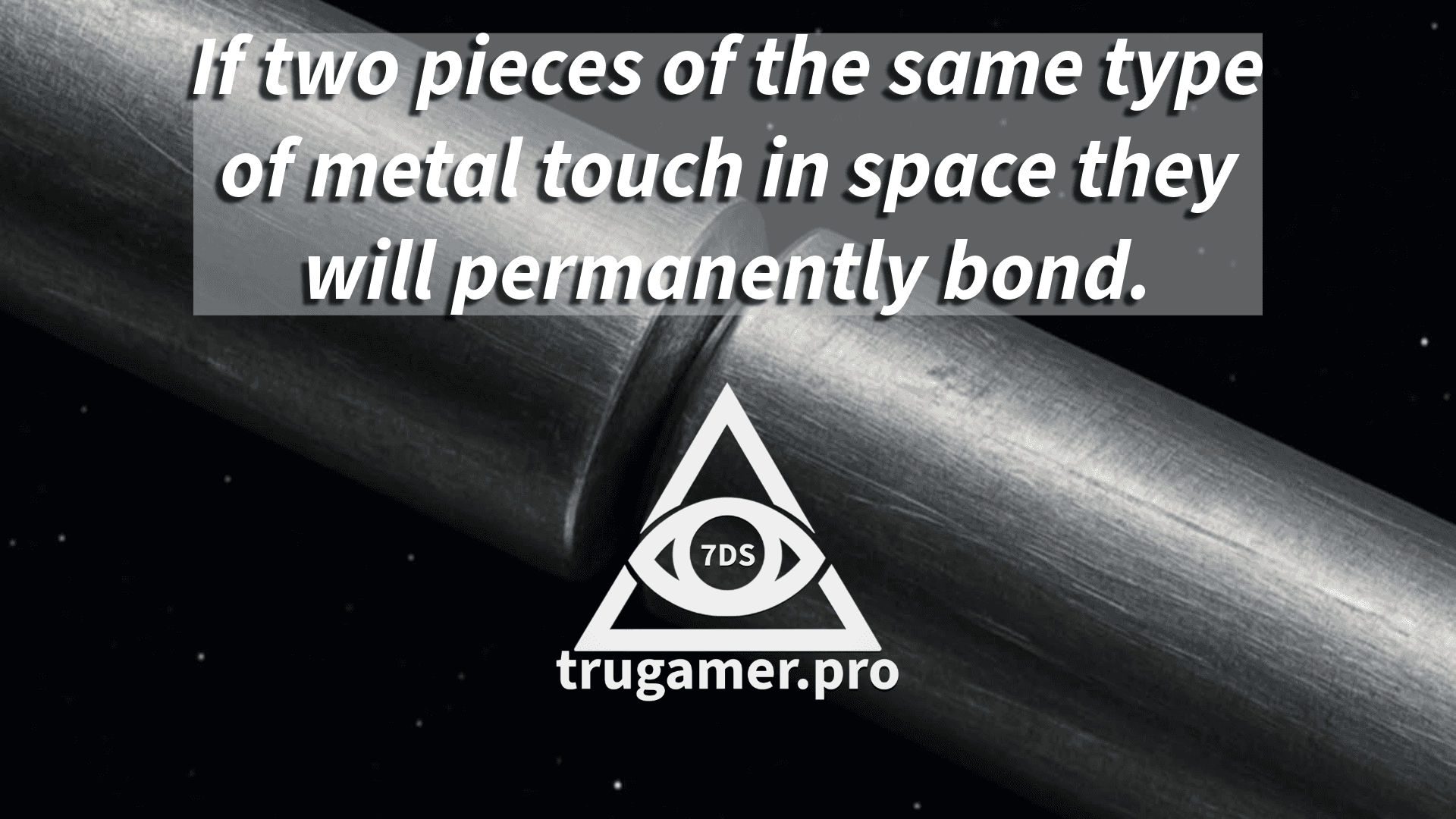
Cold Welding: In-Depth Explanation
What It Is
Cold welding is a solid-state welding process where two clean, identical metals (or alloys) fuse together at room temperature under contact pressure in a vacuum—no heat, filler, or melting required. The bond forms instantly at the atomic level.
---
Why It Happens in Space
- No atmosphere → No oxygen, nitrogen, or water vapor
- No oxide layers → Metal surfaces are atomically clean
- Direct atomic contact → Atoms from both pieces are close enough to share metallic bonds
- Lattice alignment → Atoms "recognize" the same crystal structure and merge as one continuous lattice
Example: Two polished aluminum blocks pressed together in space become one solid piece.
---
Why It Doesn’t Happen on Earth
- Oxide layer (e.g., Al₂O₃ on aluminum): Forms instantly in air; prevents atomic contact
- Adsorbed gases & moisture: Thin film of water/CO₂ blocks bonding
- Surface contaminants (dust, oils): Physically separate surfaces
Even "clean" metals on Earth have nanometer-thick oxide skins that act like invisible glue repellents.
---
Key Conditions for Cold Welding
1. Same metal/alloy (or very similar lattice structure)
2. Clean surfaces (free of oxides, contaminants)
3. Vacuum or inert environment (≤10⁻⁵ Torr)
4. Sufficient contact pressure (even light touch can work)
5. Smooth, flat surfaces (increases contact area)
---
Real-World Examples
- Apollo missions: Aluminum tools and fixtures accidentally welded in space
- Hubble Space Telescope: Cold-welded bolts caused maintenance issues
- ISS solar arrays: Galling and seizing of mechanisms due to cold welding
- Gold contacts: Used in satellites because gold doesn’t oxidize—prone to cold welding
---
Problems in Spacecraft
- Seized mechanisms (gears, hinges, latches)
- Unintended bonding of moving parts
- Difficulty in disassembly/repair
- Material transfer (galling) between surfaces
Mitigation Strategies:
- Use dissimilar metals (e.g., steel + titanium)
- Apply coatings (e.g., MoS₂, DLC)
- Add surface texturing or lubricants
- Use sacrificial oxide layers (controlled oxidation)
---
### Useful Applications
- Vacuum manufacturing: Join metals without heat-affected zones
- Nanotechnology: Bond nanowires or thin films
- Space construction: Assemble structures in orbit
- Nuclear industry: Weld reactive metals (e.g., zirconium) in inert chambers
Lab Demo: Rub two ultra-clean gold wires together in a vacuum chamber → they fuse seamlessly.
---
Fun Fact
Astronauts must never let two clean aluminum surfaces touch in space—even a light bump can permanently weld them!
---
Summary:
Cold welding is nature’s atomic Velcro—invisible, instant, and unbreakable—**only in the clean void of space**.