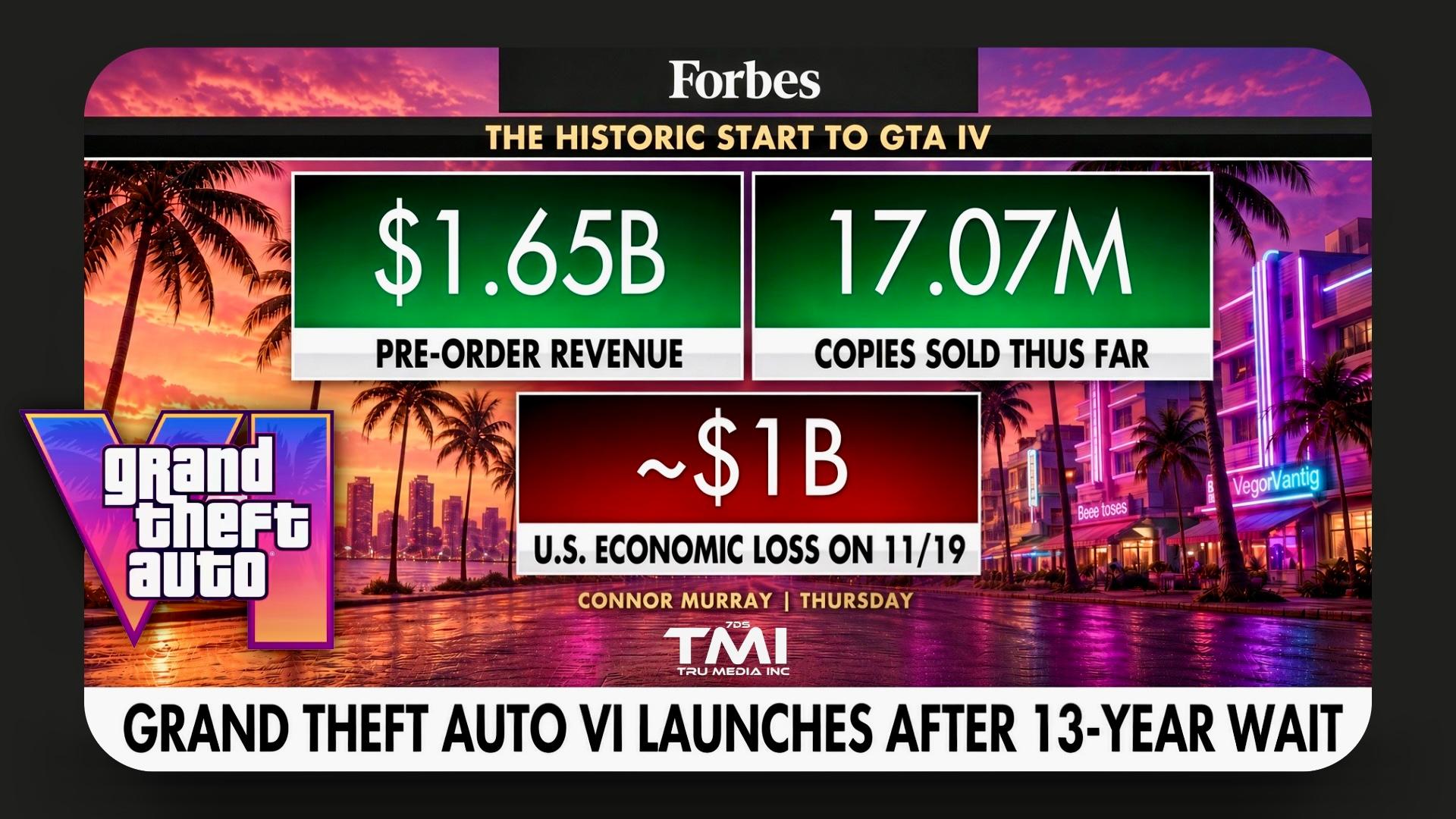
Forbes reports GTA 6 Launch Day Sparks Surge in Time-Off Requests, With Estimates of Billion-Dollar Productivity Hit Drawing Scrutiny
Grand Theft Auto VI’s highly anticipated release on November 19 has driven a measurable increase in workplace absences across the United States.
According to HR platform data and surveys, while a widely circulated projection of roughly $1 billion in lost productivity remains largely unverified.
BambooHR, drawing on anonymized records from more than 3.4 million U.S. employees, reported that paid time-off requests for the launch date ran approximately 13% higher than on comparable Thursdays in 2024 and 2025.
A separate survey of about 1,500 full-time salaried workers found that 18% planned to take the day off, with the share rising to 32% among Gen Z respondents and 27% among millennials.
Roughly half of those intending to step away for a major game release said they expected to call in sick rather than book leave in advance.
Requests also stayed elevated for the following Friday and weekend.
Other surveys of self-identified gamers pointed to even higher levels of intent, with some finding that 10% to 30% were considering or planning time off.
Younger workers and those in remote or technology roles appear most likely to be affected.
Similar patterns have been reported in other countries, including elevated absence rates in parts of Europe.
The Forbes headline figure of roughly $1 billion in lost U.S. productivity, often paired with an estimate of 1.5 million workers missing the day, traces to a rough projection by economist José García Montalvo of Pompeu Fabra University.
The calculation multiplies an assumed number of absences by an average annual worker output of about $70,000.
The estimate has not been published as a formal study, and the 1.5 million figure has primarily circulated in subsequent media retellings.
Fact-checking outlets and other economists have questioned the precision of those numbers.
Stanford economist Nicholas Bloom described the projections as more akin to social-media speculation than evidence-based forecasts, noting that only a fraction of the game’s audience would likely forgo an entire workday rather than play after hours or over the weekend.
Typical daily absenteeism among full-time salaried workers already stands near 3.2%, or roughly 3.9 million people, providing context for how large an incremental spike would need to be to register as a major national event.
The phenomenon has historical precedent.
Ahead of Grand Theft Auto V’s 2013 launch, polls also showed substantial numbers of players intending to take time off, yet measured effects on overall economic output remained limited.
Take-Two Interactive’s chief executive had previously acknowledged that many fans would call in sick on the November 19 release date.
While certain workplaces—particularly those with younger or gaming-oriented staff—appear to have experienced thinner coverage, the broader economic impact is best understood as a temporary, concentrated reduction in output rather than a large-scale national loss.
At the same time, the game itself has generated substantial revenue for its publisher through pre-orders and launch-day sales, shifting resources within the economy rather than eliminating them.