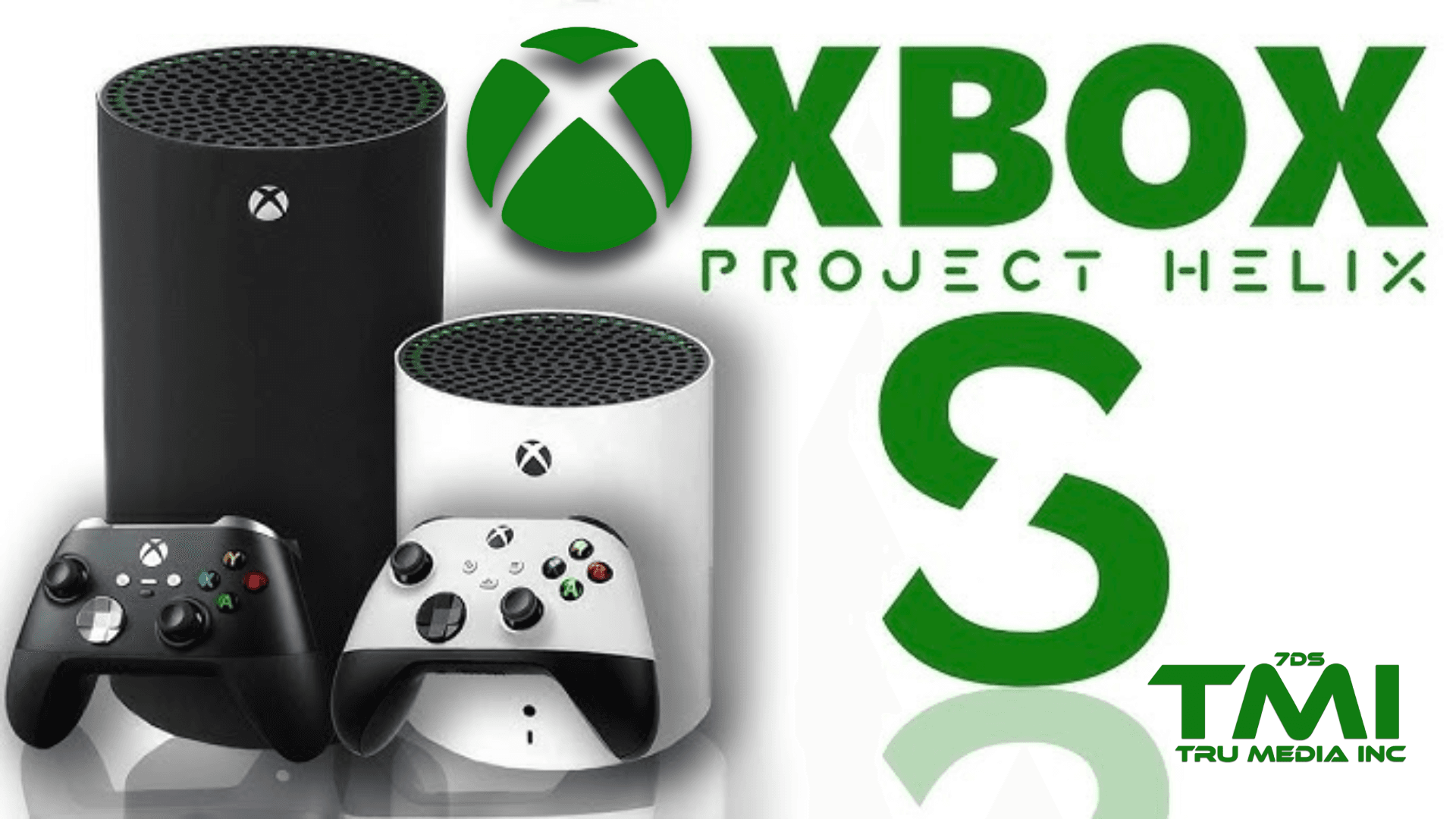
Microsoft has not released full numerical specs yet (alpha dev kits are planned for 2027, with a likely 2027–2028 consumer launch), but here’s what’s confirmed officially and what reliable leaks/rumors report.
Official Details (from Xbox announcements at GDC and follow-up dev updates)
- Hardware: Powered by a custom AMD SoC (system-on-a-chip), co-designed in deep partnership with AMD specifically for the next generation of DirectX and FSR (FSR Next / advanced FidelityFX Super Resolution).35
- Key performance claims:
- Order of magnitude leap (roughly 10x) in ray tracing performance and capability compared to current-gen consoles.
- Intelligence (AI/ML) integrated directly into the graphics and compute pipeline.
- Meaningful gains in efficiency, scale, and visual ambition → more realistic, immersive, and dynamic worlds.
- Core philosophy: “Project Helix is designed to play your Xbox console and PC games, delivering leading performance and ushering in the next generation of console gaming.”35
- It breaks down the traditional wall between console and PC development, giving devs a simpler unified path while reducing costs.0
Rumored / Leaked Specs (consistent across multiple sources as of May 2026)
These are not officially confirmed by Microsoft and could change, but they come from credible AMD/Xbox supply-chain leaks and analyst reports:
- SoC name: Custom “Magnus” APU.
- CPU: AMD Zen 6 hybrid (e.g., 3 performance cores + 8 efficiency cores / Zen 6c variants) — significant IPC and threading uplift over Zen 2 in the Series X.
- GPU: Up to 68 RDNA 5 Compute Units (vs. 52 CUs in Series X). Projected ~60+ TFLOPS, with 5–6× the rasterization performance and dramatically better ray tracing (some estimates put it in the ballpark of high-end current PC GPUs like an RTX 5080/5090 in optimized scenarios).41
- Memory: 24–48 GB GDDR7 (likely 36–48 GB in final config) on a wide bus for huge bandwidth gains.
- AI Accelerator (NPU): Up to 110 TOPS (dedicated neural processing unit) for native AI-driven features like advanced upscaling, frame generation, ray-tracing denoising, etc.
- Process node: Likely TSMC 3 nm or similar (large ~408 mm² die).
- Estimated price: Rumors point to $900–$1,200 range (higher than current consoles, reflecting the premium hybrid hardware).17
Why the news claims it will be “better than PC”
Microsoft’s own wording is that it will deliver “leading performance” when playing Xbox and PC games. Here’s the reasoning behind that hype:
- Fixed hardware + console-level optimization — Unlike a regular PC (where hardware varies wildly and games must support thousands of configurations), Helix has one fixed spec. Developers can push graphics, ray tracing, and simulation much harder with zero compromises on compatibility or performance variability. This often results in better real-world frame rates, less stuttering, and higher visual fidelity than an equivalent-spec PC.
- Deep custom silicon & next-gen tech stack — The SoC is co-engineered from the ground up with next-gen DirectX and FSR Next. The massive ray-tracing leap + AI baked into the GPU pipeline (plus the 110 TOPS NPU) enables effects (path-traced lighting, neural rendering, smarter upscaling/frame gen) that are more efficient or advanced than what most consumer PCs can do today without huge power draw or cost.
- True hybrid experience — You get the console convenience (plug-and-play, controller-first, optimized UI, instant resume, etc.) plus the full PC game library. No more choosing between “console exclusives + optimization” and “PC library + mods.” It’s positioned as the best of both worlds in one box.
- Efficiency & ecosystem advantages — Better power/thermal efficiency than a similarly powerful gaming PC, unified Xbox + PC ecosystem (Play Anywhere titles run natively), and reduced dev overhead mean games can look and run better on Helix than they would on a typical mid-to-high-end PC at similar price points.
Important caveat: A top-tier, high-end custom gaming PC (with the latest NVIDIA/AMD flagship GPU, lots of RAM, etc.) will still win on raw power and upgradability. Helix is not trying to beat every possible $3,000+ PC — it’s claiming to deliver leading console-class performance while also natively running the entire PC catalog with console-like ease and optimization. That’s the “better than PC” angle in the news coverage.22
Details are still early — Microsoft said they’ll share more hardware specifics later in 2026. Once dev kits ship in 2027 we’ll get real benchmarks. For now, the official pitch is ambitious next-gen rendering + the ultimate console/PC hybrid.