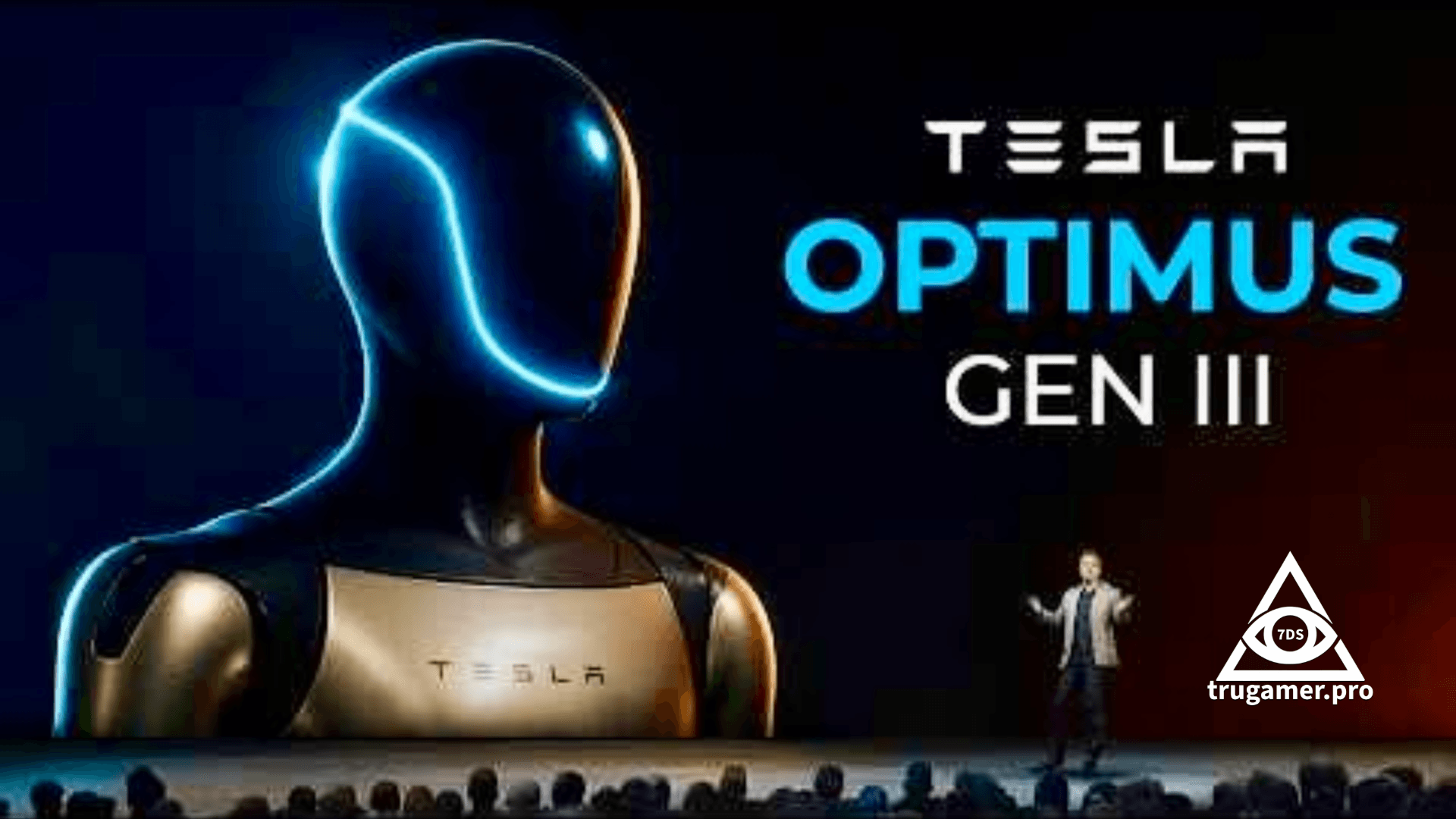
The project leverages Tesla's expertise in AI, autonomous driving hardware, and manufacturing to create a bi-pedal robot capable of navigating real-world environments. Optimus Gen 3 (often referred to as Optimus 3 or V3) represents the third major iteration, marking a significant leap in design, dexterity, and production readiness.
Announced in stages through 2024-2025, Gen 3 is positioned as the "volume production model," with Elon Musk describing it as a "remarkable robot" and a "true masterpiece" that could become Tesla's most impactful product.
It builds on prior generations by incorporating advanced AI integration, including Grok AI from xAI, and is designed for scalability in factories, homes, and beyond.
History and Development
Optimus was first unveiled at Tesla's AI Day on August 19, 2021, as a conceptual humanoid to address labor shortages and menial tasks, with Musk predicting it could eclipse Tesla's automotive revenue.
Early prototypes appeared in 2022, including a display model at the Cyber Rodeo event and semi-functional versions at the second AI Day, capable of basic walking and arm movements.
- Gen 1 (2022): Focused on proof-of-concept, with rudimentary prototypes emphasizing form over function.
- Gen 2 (2023–2024): Slimmer design, improved hands with 11 degrees of freedom (DoF) per hand, and demos like walking, dancing, and egg-poaching. Videos showed factory tasks, though some relied on teleoperation.
- Gen 3 (2024–2025): Development accelerated in 2024 with the "We, Robot" event in October, where Optimus demonstrated everyday interactions.
By March 2025, Musk announced a Mars mission for 2026. In June 2025, program head Milan Kovac resigned, replaced by Ashok Elluswamy from Tesla's Autopilot team.
Design finalization occurred by September 2025, with Musk teasing a "complete redesign" for vastly improved performance.
The Gen 3 incorporates Tesla's full-stack AI, including vision systems from Full Self-Driving (FSD) tech, and was reviewed by Musk in June 2025 as "going to be 🤌" (chef's kiss perfection).
Development draws from Tesla's vehicle tech—no acquisitions involved, built as an internal "startup." As of November 2025, pilot production is active in Fremont, California, with hundreds of units built and testing underway in factories and offices.
Technical Specifications
Optimus Gen 3 is engineered for human-like agility and efficiency, with a modular design optimized for mass production. Key specs include:
- Dimensions and Build:
- Height: 1.73 m (5 ft 8 in)
- Weight: 57 kg (125 lb)
- Carrying Capacity: 20 kg (45 lb)
- Actuators and Mobility:
- Total Actuators: 50 (28 for main body joints—rotary and linear for arms, legs, torso, neck; 22 for hands—11 per hand via tendon-driven mechanisms)
- Degrees of Freedom: 22 in hands for precise manipulation; overall agility comparable to an "agile human."
- Hands: Highly dexterous, capable of delicate tasks like catching objects or surgical assistance; 11 DoF per hand for sophisticated gripping.
- Power and Compute:
- Battery: 2.3 kWh pack
- Power Consumption: 100 W idle, 500 W during intensive activities
- Compute: AI5 brain with 50x the throughput of predecessors; powered by Tesla's FSD AI system and integrated Grok for natural language processing.
- Sensors and AI:
- Vision: Stereo cameras for alignment and navigation (e.g., auto-docking at charging stations)
- AI Stack: Full Tesla AI for real-time learning from a global fleet; supports end-to-end autonomy without human intervention.
The design emphasizes modularity for easy repairs and scaling, with a bill of materials (BOM) targeted at $20,000 per unit at volume.
Capabilities and Features
Gen 3 shifts from teleoperated demos to full autonomy, excelling in dynamic environments:
- Manipulation and Dexterity: Handles fragile objects (e.g., eggs, surgical tools); performs precision tasks like sorting, cooking, cleaning, or assisting in operations.
Demos include poaching eggs, yoga poses, and factory assembly.
- Mobility: Fluid walking, dancing, and navigation; auto-aligns for charging without human help.
- AI Integration: Uses Grok for conversational interactions; learns from Tesla's vehicle data for real-world adaptation. Capable of 15-minute household chores like meal prep and cleaning.
- Use Cases: Factory testing for repetitive tasks; potential in healthcare (surgical aid), agriculture (via partnerships for 10,000 units in farming and drug manufacturing), logistics, construction, and home assistance.
Energy efficiency allows 8-10 hours of operation per charge, with idle modes for sustainability.
Production and Availability
- Current Status: Pilot line in Fremont operational as of November 2025, producing hundreds of units monthly, scaling to thousands by year-end. A $685 million actuator order supports ~180,000 units.
- Gen 3 Rollout: Larger production line launches in 2026, with initial units arriving February-March.
Limited internal deployment (1,000+ for Tesla factories) in 2025; external sales start 2026.
- Pricing: Estimated $30,000 retail; $20,000 cost of goods sold (COGS) at scale for profitability.
- Supply Chain: Modular components from Tesla's ecosystem; partnerships like one for 10,000 units in pharma/agri ops highlight early adoption.
Annual output could reach 1 million units from the pilot line alone.
Future Plans
Musk envisions annual iterations (Gen 4, 5 teased at 2025 Shareholder Day), with Gen 3 as the foundation for mass adoption. Key milestones:
- Space Integration: Uncrewed Mars landing in 2026 via SpaceX Starship, potentially crewed by Optimus in late 2026 (low probability).
- Scaling: Self-sustaining Mars city in 20-30 years; Earth-side GDP boost of 5-12% by 2035 via automation.
- Ecosystem: Integration with Tesla vehicles, Robotaxi, and Grok for multi-modal AI; potential for 1 billion job displacements, redefining labor as a "utility."
Reception and Impact
Gen 3 has generated hype, with Musk calling it "dripped out" and demos like post-award dancing going viral.
However, skepticism persists from early days—critics like Gary Marcus and Filip Piekniewski labeled prototypes as "hype" or "scams," citing teleoperation and humanoid form factor challenges. Recent praise focuses on Tesla's rapid progress (2 years to match, 3 to beat competitors like Boston Dynamics).
Societally, Optimus 3 could collapse labor costs to near-zero, enabling post-scarcity economies but risking massive job loss in manufacturing, logistics, and services.
Geopolitically, it shifts power to AI/autonomy leaders like Tesla. Watch Q1 2026 metrics (BOM audits, failure rates) for validation.
Named after Transformers' Optimus Prime, it embodies Musk's vision of AI as humanity's amplifier.