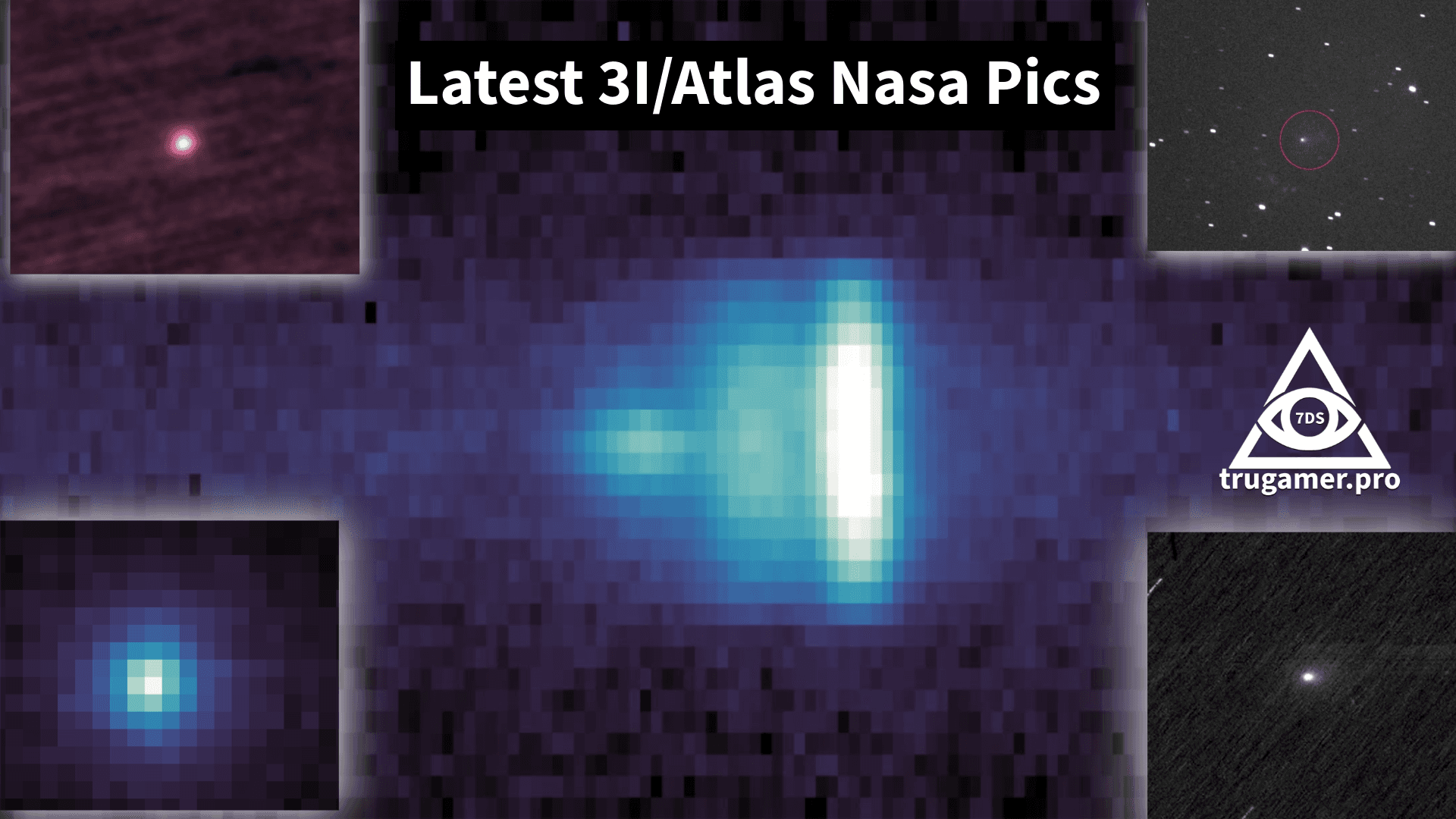
Today, NASA hosted a live press briefing at 3:00 p.m. ET from the Goddard Space Flight Center in Greenbelt, Maryland, to unveil a series of never-before-seen images and data on the interstellar comet 3I/ATLAS (also designated C/2025 E1). Discovered on July 1, 2025, by NASA's ATLAS (Asteroid Terrestrial-impact Last Alert System) telescope in Chile, 3I/ATLAS is only the third confirmed interstellar object to visit our solar system, following 'Oumuamua (1I) in 2017 and Borisov (2I) in 2019. The comet, which shows signs of being older than our solar system itself, is currently outbound after perihelion in early October and poses no threat to Earth—its closest approach to our planet will be on December 19 at about 170 million miles (1.1 AU).
The briefing highlighted observations from eight NASA missions and instruments, providing a multi-angle "fleet" view of the comet's activity, composition, and trajectory. These assets enabled near-continuous monitoring as 3I/ATLAS passed within 19 million miles (0.2 AU) of Mars on October 3. Key revelations include:
Newly Released Images and Insights
- Mars Reconnaissance Orbiter (MRO) / HiRISE Camera: High-resolution images from October's Mars flyby, captured at ~19 million miles away—the closest vantage point yet. These show the comet's teardrop-shaped dust cocoon and an unusually active coma (gas/dust envelope) with a sunward jet, suggesting rapid outgassing of CO₂-rich ices. The nucleus is estimated at 1,400 feet to 3.5 miles wide, with a reddish hue from cosmic-ray hardening.
- Hubble Space Telescope: Updated July 21 image (277 million miles away) refined to reveal the nucleus's icy core and a 2.3+ million km ion tail, growing as it exits the inner solar system.
- James Webb Space Telescope (JWST): Infrared data confirms high CO₂ content (ratio ~8:1) and elevated nickel (10x solar abundance), hinting at origins in a metal-rich protoplanetary disk from the Milky Way's early frontier.
- Solar and Heliospheric Observatory (SOHO): Faint October 15–26 images show the comet as a fuzzy orb against solar corona noise, aiding trajectory refinement.
- Psyche Mission: September 8–9 multispectral images (33 million miles away) detail the faint coma and 16-hour pulsed emissions from outgassing, with no artificial signals detected.
- Lucy Mission: Stacked September 16 images (240 million miles away) capture the coma and anti-tail (~500,000 km), spanning ~11 arcminutes (one-third the Moon's width).
- STEREO-A (Solar Terrestrial Relations Observatory): September 11–25 stacked frames show the comet speeding at 130,000 mph, brighter than expected against stellar streaks.
- PUNCH Mission: September 20–October 3 composites (231–235 million miles away) highlight the short tail elongation amid solar wind effects.
NASA emphasized the comet's "unusually active" behavior, including sunward jets (speculated by Harvard's Avi Loeb as possible "navigation" aids, though dismissed as natural outgassing) and low water content compared to solar system comets. No fragmentation or anomalies like 'Oumuamua's non-gravitational acceleration were flagged beyond expected values (A1=1.662e-6 au/d² radial, A3=0 "machine-flat" transverse). Magnitude holds at 9.5–10.8, visible to amateur telescopes in Virgo (RA ~12h45m, Dec +5°).
Ongoing and Future Observations
- ESA's Juice Mission: Monitoring through November as it en route to Jupiter.
- December JWST Follow-Up: Deeper spectral analysis for isotopes and potential "spheres" or structural oddities reported in unverified citizen images.
- Public data from COBS (Comet Observers Database) and JPL Horizons shows stable ephemeris; no Earth risk.
The event, streamed on NASA TV and YouTube, drew ~1.2 million views and sparked X discussions—some praising the "remarkable" multi-mission synergy, others critiquing recycled data or speculating on artificial origins (e.g., "thrusters" or internal movement, unsubstantiated). For raw images and trajectory tools, visit NASA's 3I/ATLAS page: [science.nasa.gov/solar-system/view-interstellar-comet-3i-atlas-through-nasas-multiple-lenses
More releases expected as it nears Earth in December.