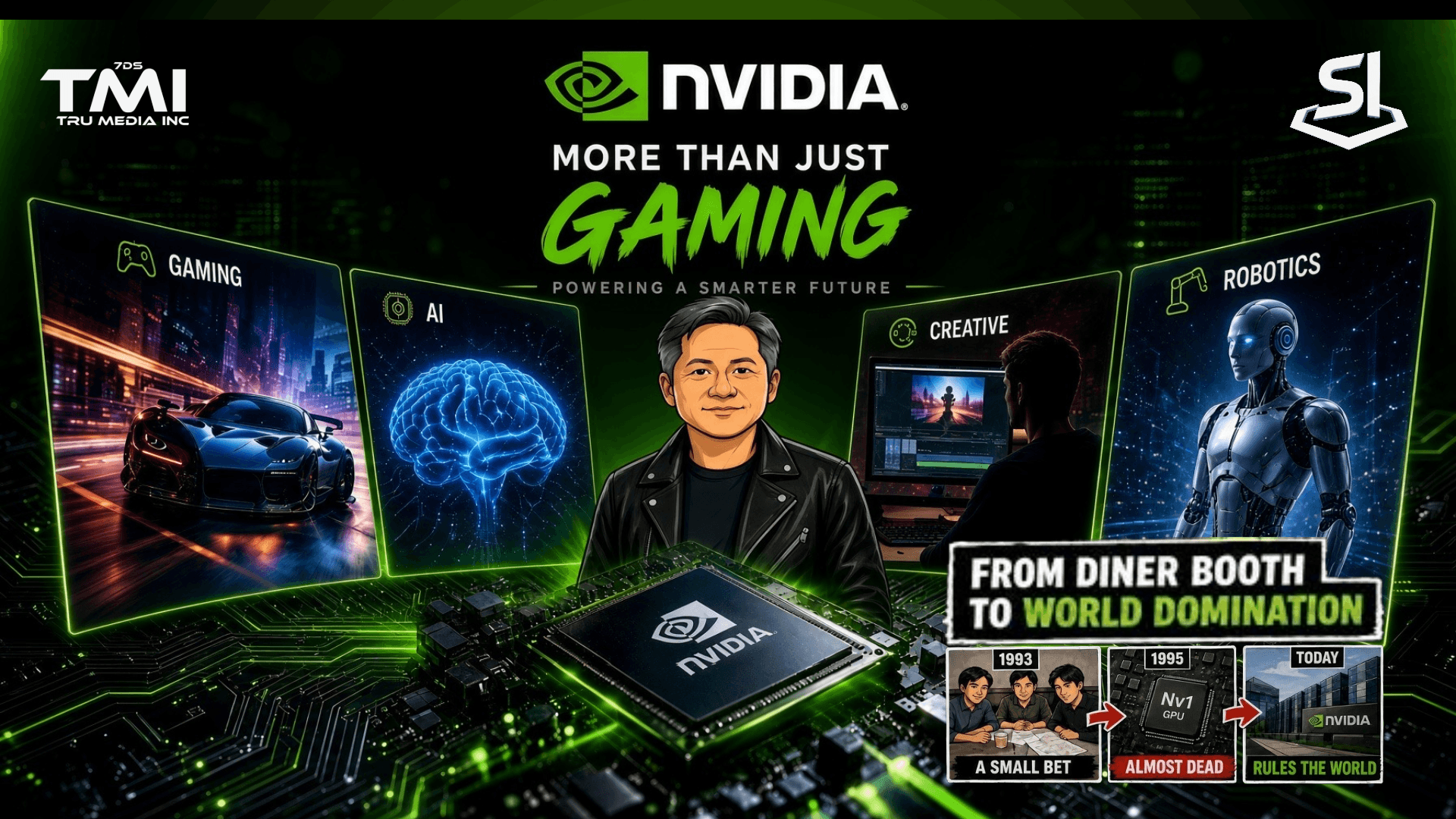
Nvidia’s story is one of the wildest in tech history: a company that started by making graphics cards for PC gamers now builds the machines that train and run the world’s most powerful AI models.
From Gaming to the AI Engine
Nvidia was founded in 1993 by Jensen Huang, Chris Malachowsky, and Curtis Priem.
Their early goal was simple: better 3D graphics for games.
They nearly went under multiple times (the unofficial early motto was “30 days from going out of business”).
The breakthrough came in 1999 with the GeForce 256, which Nvidia marketed as the world’s first GPU.
Then, in 2006, they made a high-stakes bet: CUDA.
This software platform let programmers use GPUs for general math and science, not just graphics.
Huang insisted on putting it in every GPU, even though most customers were gamers who would never use it.
Gamers essentially subsidized the creation of general-purpose GPU computing.
That bet paid off spectacularly in 2012 when AlexNet — a neural network trained on two Nvidia gaming GPUs — crushed the ImageNet competition.
Researchers suddenly realized GPUs were perfect for the parallel math of deep learning.
From there, Nvidia added Tensor Cores, built DGX systems, and methodically turned itself into the default AI infrastructure company.
Today, data center revenue accounts for roughly 90-93% of the business. Gaming is a sideshow by comparison.
Blackwell: The Chip That Defined the Current AI Boom
Blackwell (named after mathematician David Blackwell) was the big architectural jump after Hopper.
It used a dual-chiplet design on TSMC’s 4nm process, delivered major AI performance gains, and introduced upgraded NVLink interconnects.
Systems like the GB200 NVL72 (72 GPUs tightly linked in a liquid-cooled rack) became the standard for large-scale training and inference.
Blackwell dominated MLPerf benchmarks and powered the explosive buildout of AI data centers.
It remains a workhorse even as the next generation arrives.
What’s Happening Right Now (November 2026)
Nvidia just reported another monster quarter: $115.8 billion in revenue (up 103% year-over-year), with data center revenue of $107.6 billion.
They’re guiding next quarter to about $130 billion and raised their longer-term growth outlook to 75%.
At the same time, the company is in the middle of a major leadership transition. Jensen Huang resigned amid personal scandals involving extramarital affairs (one involving a woman reportedly under investigation for possible ties to Chinese intelligence).
Longtime CFO Colette Kress is now interim CEO.
The board has stated it does not intend to reinstate Huang and has named Harvey Jones as the first independent board chair.
Despite the drama, the business is described as “business as usual” with strong customer and supplier support, and Vera Rubin is off to an “explosive start.”
What’s Next: Vera Rubin and Beyond
Vera Rubin is the current flagship platform — the successor to Grace Blackwell. It is not just a faster GPU. It is a full codesigned system:
• Rubin GPU + Vera CPU (Nvidia’s own custom data-center CPU)
• Sixth-generation NVLink
• Advanced networking, BlueField DPUs, and other specialized chips
The flagship Vera Rubin NVL72 rack packs 72 Rubin GPUs and 36 Vera CPUs in one liquid-cooled, tightly interconnected domain.
Nvidia claims major efficiency gains — up to roughly 10x lower cost per token on some inference workloads and the ability to train large mixture-of-experts models with far fewer GPUs than Blackwell.
In its first MLPerf appearance (November 2026), Vera Rubin NVL72 delivered up to 2x the per-GPU performance of highly optimized Blackwell Ultra (GB300) systems and swept or led most benchmarks.
It is already shipping to major cloud providers (CoreWeave, Oracle, Google, Microsoft, etc.) and is described as the fastest product ramp in company history.
Further out:
• Rubin HPC — a specialized version with over 50,000 CUDA cores aimed at scientific simulation and data processing, expected around 2028.
• Rubin Ultra and then Feynman further down the roadmap.
The bigger picture is that Nvidia is no longer just selling GPUs.
It is selling entire AI factories — compute, networking, CPUs, software, and systems optimized for agentic AI, massive-context models, and scientific workloads.
Demand remains intense, supply is still constrained in places, and the performance gains per generation continue to be dramatic.
The excitement is real: the machines that started as tools for prettier video games are now the engines of the AI age, and the next generation is already rolling into data centers.