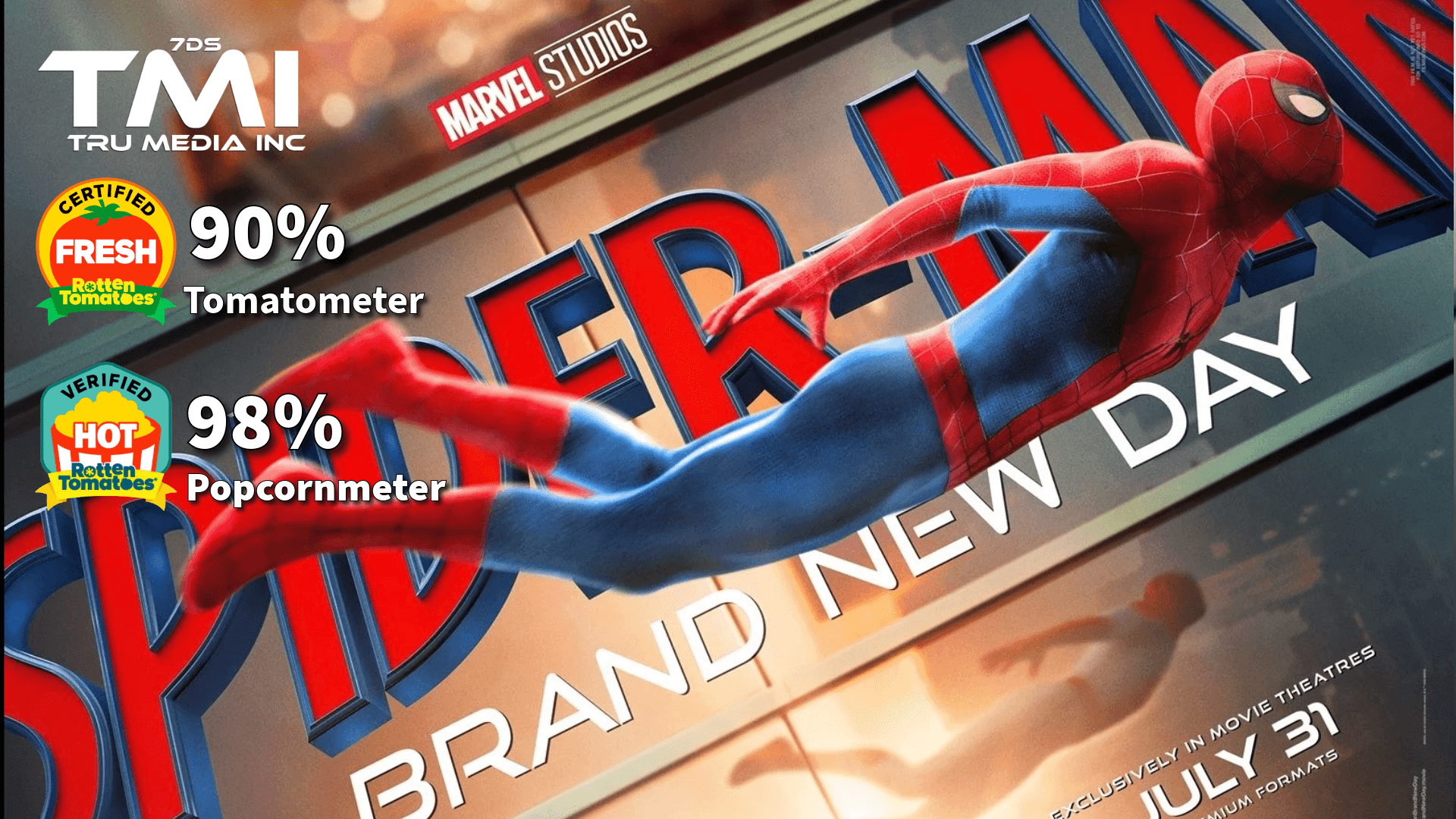
Spider-Man: Brand New Day (released July 31, 2026, directed by Destin Daniel Cretton) is Tom Holland’s fourth solo MCU Spider-Man film.
It picks up four years after No Way Home, with strong critical and audience reception and massive box office success.
Reviews and Reception
Critics have largely praised it as a more mature, grounded entry.
It holds around 90–91% on Rotten Tomatoes (Certified Fresh) with a very high audience score (reported near 98% in early tracking).
Metacritic sits in the mid-60s (generally favorable).
Common points from reviews:
- Many call it the best live-action Spider-Man film since Sam Raimi’s Spider-Man 2 (2004), or the strongest of the Holland era. Outlets like The Independent, The Telegraph, Polygon, and Collider highlighted its emotional depth, action craft, and focus on the character over franchise spectacle.
- Strengths: Holland’s more nuanced, mature performance; better action (drawing from comics and the Insomniac games, with inventive web-slinging and high-frame-rate sequences); a true New York street-level feel; strong supporting turns (especially Jon Bernthal’s Punisher and Sadie Sink in a key role); and a balance of heart, humor, and drama.
- Criticisms: Some note it is denser/heavier and less breezily fun than the earlier Holland films (partly because the Ned/MJ chemistry is constrained by the story setup). A few found the plot overstuffed or felt certain subplots were underdeveloped. The New York Times found it less entertaining than prior entries while acknowledging its coming-of-age themes.
It has been a huge commercial hit, with a record-breaking domestic opening (~$360 million) and worldwide gross already well over $1.6 billion in its early run, setting multiple box-office records.
Story Overview (Spoiler-Light)
Peter Parker lives in isolation as a full-time Spider-Man. Because of the spell from No Way Home, the world (including MJ and Ned) has forgotten him.
He has thrown himself completely into crime-fighting in New York while dealing with loneliness, the lingering effects of loss (including Aunt May), and seeing his old friends move on.
Stress and isolation trigger physical changes in his powers—he develops organic web-shooters (like the Tobey Maguire version) and experiences more aggressive, spider-like side effects that he struggles to control.
A mysterious new threat emerges involving body-hopping/psychic control and the Department of Damage Control.
Peter forms an unlikely working relationship with the Punisher (Jon Bernthal) and crosses paths with other MCU figures (including Bruce Banner).
The story centers on Peter confronting what it means to accept both his powers and the need for human connection rather than pure isolation.
What’s Different / Why Many Call It Better
- More grounded and character-focused: It steps back from multiverse spectacle and heavy MCU crossover obligations. Reviewers repeatedly note it feels like a pure Spider-Man story about the character himself—loneliness, responsibility, growing up, and the cost of the hero life—rather than primarily serving larger franchise setup.
- Maturity and emotional stakes: Peter is an adult dealing with the long-term consequences of his No Way Home sacrifice. The tone is more introspective and melancholic at times (compared to the lighter high-school/college energy of the prior trilogy), with stronger dramatic payoff in the core relationships.
- Action and style: Destin Daniel Cretton brings a different directorial energy. Action is frequently described as the series’ best—more inventive, showy, and rooted in classic Spidey agility and web creativity, with organic webs enabling new combat approaches. It has a stronger “lived-in New York” atmosphere.
- Power evolution and tone shift: The organic webs and body-change elements echo classic comic and Raimi-era beats while feeling fresh in this continuity. The film leans into the “with great power…” theme in a more adult register.
- Supporting dynamics: The Spidey/Punisher pairing is a frequent highlight (buddy-friction energy). Returning characters are handled with the weight of the memory wipe, creating poignant rather than purely comedic scenes.
In short, many critics and audiences see it as a successful “reset” that prioritizes Peter Parker’s personal journey and classic Spider-Man DNA over the previous films’ broader MCU integration and lighter tone. It is widely regarded as a high point for the live-action Holland series and one of the stronger recent superhero films.
The film ends in a way that leaves room for continuation (“Spider-Man will return”), with post-credits material teasing future possibilities.